
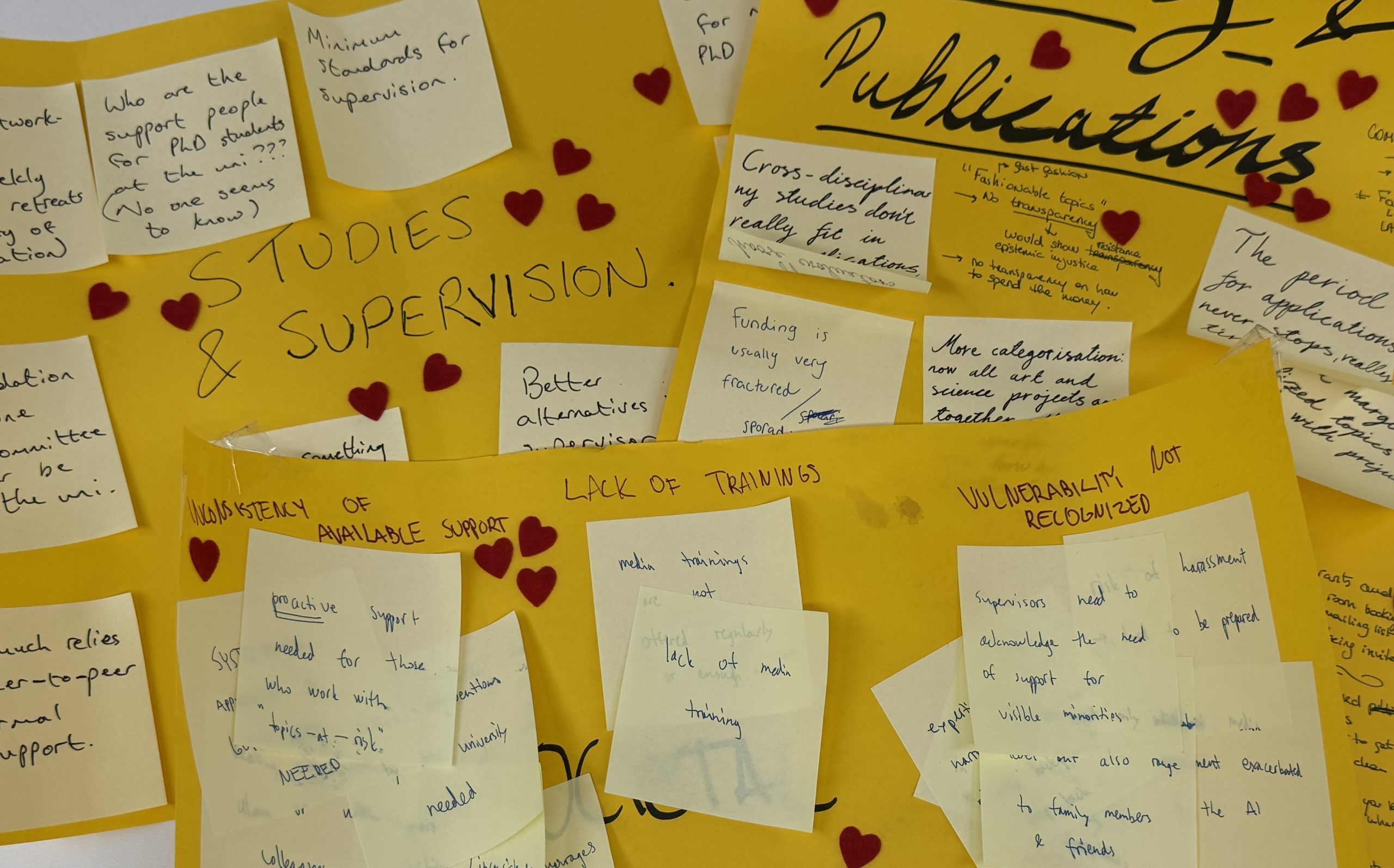
Discussion points from the University of Helsinki’s Student Jury
In November 2025, the CCINDLE team in Helsinki took an important step toward strengthening democratic and inclusive practices within academia. As part of Work Package 5, on co‑creation, the team organized a Student Jury; a format inspired by citizen assemblies, and designed to bring doctoral researchers directly into conversation with university leadership on issues of concern.
Fifteen doctoral researchers from the University of Helsinki – each working on intersectional, feminist, queer, trans, and critical race research – were invited to join the session. Their research areas often place them at the centre of public debate and, at times, involve personal risk. For that reason, their insights are crucial when shaping measures that aim to make universities more inclusive, democratic, and safe.
The workshop followed a World Café format, with three rounds of intensive discussions facilitated by Matti Pihlajamaa and Valentine Berthet (from the University of Helsinki) and Rylan Verlooy (from the University of Antwerp). We asked participants to reflect first on the challenges they encounter during their doctoral journey, and then on the transformations that they would like to see within the university.
We structured the conversations around three primary themes:
- Studies and Supervision
- Funding and Publications
- Societal Dissemination
Researchers shared concrete personal experiences, highlighting not only individual struggles but also deeper, persistent structural issues across the institution. For instance, PhD students reliant on grants are less integrated within the university than those on a salaried position and are more dependant on individual supervisors, which leads to an unequal distribution of information and learning opportunities. Likewise, PhD students working on ‘risky’ topics are not sufficiently supported by the university in cases of harassment when disseminating their research findings.
The workshop produced a clear and actionable set of recommendations (see full report here). The CCINDLE team presented this to various stakeholders at the University of Helsinki Faculty of Social Sciences, including the Dean, the Vice-Dean for research, the Director of the doctoral programme, and the University Doctoral School, as well as student’s unions and representatives. Key headlines from the report are highlighted below.
Studies and Supervision
Participants advocated for:
- A comprehensive crash course developed by and for PhD students, offering a clear overview of the doctoral process.
- University-wide supervision guidelines to ensure minimal standards in all supervisee-supervisor relationships.
- An anonymous reporting mechanism for supervision-related issues.
- Regular writing retreats financed by the doctoral school to support peer networking.
The university should regularly survey PhD students to improve studies from the students’ perspectives.
Funding and Publications
Precarity remained a central theme. Participants pointed to:
- The fragility of funding mechanisms.
- A lack of constructive feedback after unsuccessful funding or job applications.
- Unequal treatment of PhD students, whose access to services and spaces often depends on their funding status.
Participants demanded equal treatment for all, regardless of their funding.
Societal Dissemination
For researchers working on salient, politicized or polarizing topics, or belonging to marginalized groups, public engagement can come with risks. Participants emphasized:
- Insufficient training on how to communicate research safely and effectively.
- Inconsistent institutional support in cases of harassment.
They stressed the need for proactive measures protecting PhD students working on contested topics, with clear university-wide procedures for managing harassment and providing support.
In March 2026, CCINDLE team discussed each of the workshop’s key points at a meeting organised by the Dean of the Faculty of Social Sciences. While the discussion revealed gaps in communication between PhD students and university leadership, it also showed that the latter is open to receiving feedback and suggestions for improvements directly from PhD students’ experiences. The workshop’s recommendations were positively received by the Dean, even though institutional constraints remain. One example raised was difficulties in updating the faculty mailing list due to slow information flow between different university services.
A key takeaway for PhD students is the importance of flagging issues to their student representatives, who can help keep their concerns visible and push for change.
Author: Valentine Berthet, University of Helsinki. 14th April 2026